

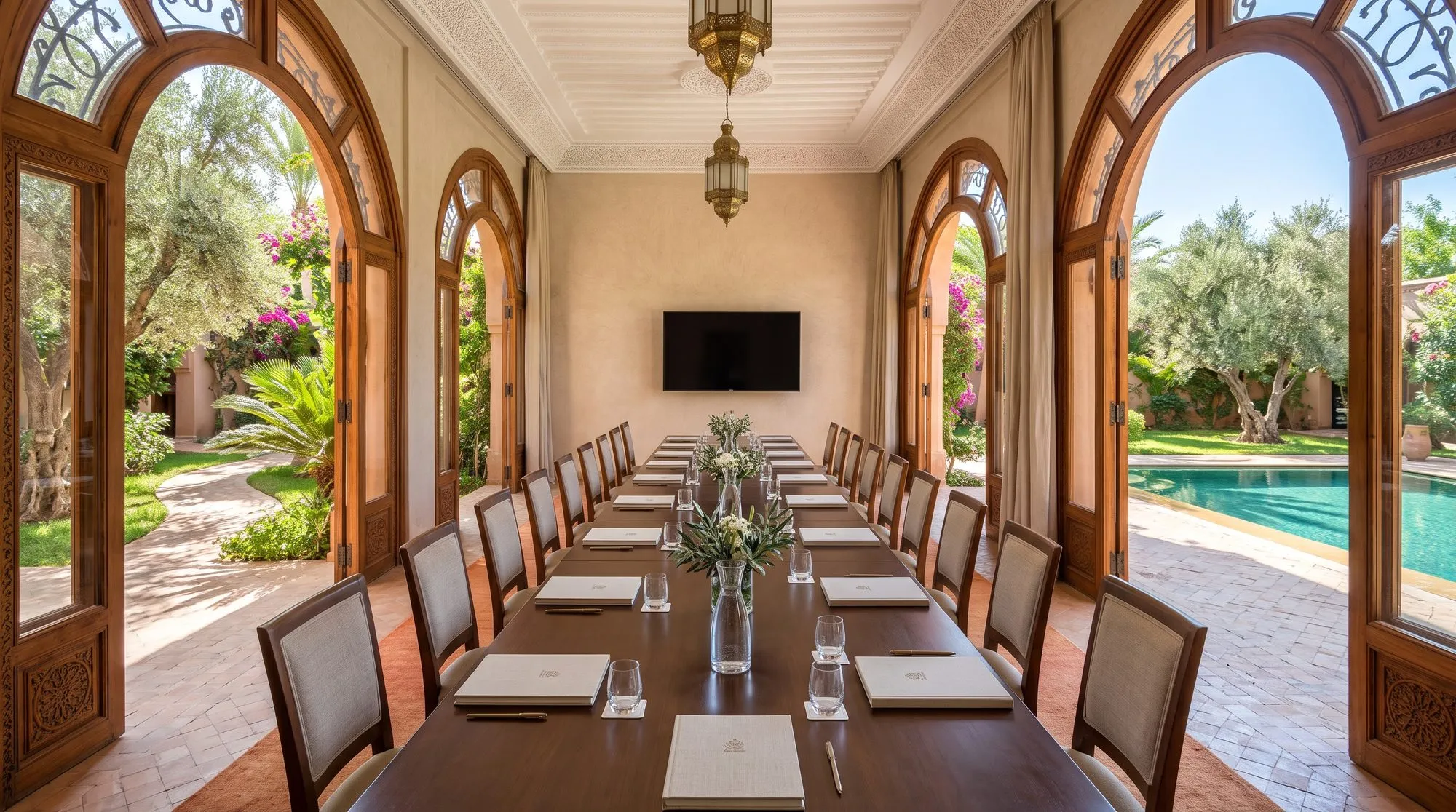
Organising a company retreat in Morocco is a project with many moving parts: objectives, dates, flights, venue, agenda, activities and communication to employees. Done well, it gives a team time to align and to know each other better. Done in a hurry, it becomes a series of logistics problems that distract from the reason for going.
This guide is written for HR directors, People and Culture leads, office managers and event managers at European companies of 20 to 250 people. It follows the order in which decisions usually need to be made, and ends with a checklist you can adapt for your own planning.
Step 1: Define what the retreat is for
Every other decision depends on this one. Before looking at venues or dates, write down in two or three sentences what the retreat should achieve. Common objectives include:
- Strategic alignment. Agreeing priorities for the next six or twelve months, or explaining a change in direction.
- Integration. Bringing together teams that rarely meet in person, after a period of growth, a merger or a move to remote work.
- Recognition. Thanking a team after a demanding year or a major delivery, often as an incentive trip.
- Team development. Improving communication and trust within a leadership group or across departments.
The objective sets the balance between work and social time. A strategy retreat might be 60% sessions and 40% activities; an incentive trip might reverse that. Writing it down early also gives you the argument you will need when presenting the project to leadership, and a reference point when choices become difficult later.
Practical tip: ask two or three people from different levels what they would want the retreat to achieve. Their answers often reveal priorities that leadership has not considered.
Step 2: Choose the dates and the season
Morocco has a long comfortable season for business travel, but timing still matters.
October to May is the most practical period for a company retreat in Morocco. In Marrakech, days are mild to warm and mostly dry, which makes outdoor lunches, garden breaks and desert evenings realistic. Evenings from December to February can be cool, so venues with heated indoor spaces are preferable.
June to September is hot in Marrakech, particularly in July and August. A retreat is still possible, with activities scheduled early and late and most sessions indoors, but it is less suited to programmes with a lot of outdoor time.
When choosing dates, check:
- Your own calendar. Avoid quarter-end, product launches, school holidays in the countries your team lives in and periods when key people are unavailable.
- Ramadan. The dates move each year. Business and tourism continue, but some daytime services and opening hours change, and Morocco usually shifts its clocks during this period. It is worth knowing the dates before choosing.
- Days of the week. A Tuesday-to-Thursday or Wednesday-to-Friday retreat often has better flight availability than a weekend and protects employees’ personal time.
Lead time. For a group of 40 or more, three to six months is comfortable. Spring and autumn dates book early, so the larger the group, the earlier you should start.
Step 3: Confirm group size and who is invited
The size of the group determines the type of venue, the number of rooms, the transfer logistics and the activities that will work. Settle three points early:
- Who is invited. The whole company, a department, the leadership team or a selected group of high performers.
- Whether attendance is expected or optional. This affects how you communicate and how many people will actually travel.
- Partners and plus-ones. Most working retreats do not include them; some incentive trips do. Decide before you announce anything.
Keep a working estimate with a range, for example 45 to 55 people, until the final list is confirmed. Venues can usually work with that during the proposal stage.
Step 4: Choose a venue type
In Marrakech, there are three main options for a company retreat.
Private estates in the Palmeraie or on the road to the Atlas suit groups of roughly 20 to 80. They offer privacy, gardens, pools and indoor rooms that can be set up for meetings. The group has the place largely to itself, which helps create the sense of a shared retreat.
Hotels with conference facilities suit larger groups and seminars. Everything is on one site: bedrooms, plenary rooms, breakout rooms and catering. They simplify logistics when numbers exceed what a private property can host.
Villa buyouts suit leadership teams and small departments of under 25. One or two neighbouring villas give a relaxed setting, with a living room or pavilion used for sessions.
Whichever type you choose, check these points before committing:
- A meeting room large enough for the full group in the layout you need (theatre, classroom, U-shape or cabaret).
- Breakout spaces, indoors or outdoors, for smaller workshops.
- Fibre Wi-Fi capable of supporting every participant connecting at once, and a wired connection for presentations or hybrid sessions.
- Screen or projector, sound system and microphones.
- Bedroom configuration: how many people share, and whether everyone can stay on site.
- Distance from the airport and from the places where activities will take place.
A video walkthrough of the venue is a useful way to validate these points without a site visit.
Step 5: Design the agenda
A good retreat agenda leaves space. The most common mistake is to fill every hour, which leaves people tired and reduces the value of the sessions.
A typical three-day structure looks like this:
- Day 1: arrival, lunch, a two-hour opening session to set objectives, welcome dinner.
- Day 2: a full morning of work (plenary and breakouts), a shared activity in the afternoon, a closing dinner.
- Day 3: a final session focused on decisions and next steps, closing lunch, departures.
A few principles help:
- Put the most demanding sessions in the morning, when attention is highest.
- Limit plenary sessions to 90 minutes before a break.
- Use breakout groups for discussion and plenaries for decisions and announcements.
- Leave free time. An hour or two without a plan each day gives people time to rest, call home or talk informally, which is often where useful conversations happen.
- End with concrete outputs. Owners, deadlines and a short written summary turn the retreat into work that continues after it.
If you use an external facilitator, involve them in agenda design rather than only in delivery.
Step 6: Choose activities that serve the objective
Activities should support the purpose of the retreat. One shared activity per day is usually enough, placed after the main work session.
Around Marrakech, the options fall into a few categories:
- Cooperative challenges, such as a cooking contest, a treasure hunt in the medina or desert games in Agafay, about 40 minutes from the city.
- Outdoor experiences, such as a day in the Atlas mountains around Imlil, about 90 minutes away, or quad and buggy circuits.
- Recognition moments, such as a dinner in the desert, a gala evening or a sunrise balloon flight for a smaller group.
- Calmer formats, such as craft workshops or guided walks, for teams that prefer lower intensity.
Always plan an inclusive alternative for physical activities, so that colleagues with different fitness levels, mobility needs or preferences can take part without being singled out. Our page on team building in Marrakech describes ten formats with group sizes and objectives.
Step 7: Organise travel and on-the-ground logistics
Flights. Marrakech Menara airport (RAK) has direct flights from more than 20 European cities, and the flight from London takes about three and a half to four hours. Book as soon as dates are fixed, as fares and availability change quickly in high season. Decide early whether employees book their own flights within a set window or whether flights are booked centrally.
Arrivals. Groups rarely arrive on a single flight. Plan transfers by arrival wave, with a meeting point and a named contact at the airport. Licensed vehicles with professional drivers are the norm for company groups.
Time zone. Morocco is at most one hour apart from London for most of the year, which makes it easy for participants to stay in touch with colleagues at home.
Documents. Collect passport nationalities early. UK, Irish, EU, US and Canadian citizens do not need a visa for a short stay; other nationalities may, and the application can take several weeks.
Duty of care. Confirm that transport and activity providers are licensed and insured, collect emergency contacts and medical information confidentially, and make sure participants travel with their own travel insurance.
Dietary and accessibility needs. Collect them with the participant list and share them with every venue and supplier. Vegetarian, vegan, gluten-free and allergy requirements are straightforward to plan for when known in advance.
Step 8: Communicate with employees
Good communication reduces questions, increases attendance and sets the tone for the retreat. Plan three stages.
Announcement (two to four months before). Explain why the retreat is happening, when and where, who is invited and what is expected of them. Ask for any constraints, such as caring responsibilities, accessibility needs or passport issues, as early as possible.
Practical information (four to six weeks before). Share flight details or booking instructions, the outline agenda, what to pack, a short cultural briefing and a single contact for questions. For Marrakech, mention that covered shoulders and knees are appropriate in the medina, that evenings can be cool from November to March, and that alcohol is available in hotels and licensed venues but not consumed in public spaces.
Final details (one week before). Confirm transfer times, room allocations, the full agenda and the on-site contact. Keep the message short and easy to find on a phone.
Throughout, make it clear how employees can raise concerns privately, and keep a single, up-to-date source of information rather than several conflicting emails.
Step 9: Decide whether to work with a planner
A company retreat in Morocco can be organised internally, but it involves many suppliers, a different language environment and on-the-ground coordination that is hard to manage from abroad. Working with a planner means one contact handles venues, transfers, activities, catering and timings, while your team focuses on the content of the retreat.
At Marrakech Group Escapes, the process is a brief from your side, a proposal within 48 hours, a video site visit, a final list and coordination on site, with every service delivered by licensed local partners. You can read more on our page about corporate retreats in Marrakech or see the steps on how it works.
Company retreat checklist
Use this as a starting point and adapt it to your project.
Three to six months before
- Objective of the retreat written and agreed with leadership
- Group size range and invitation scope decided
- Dates chosen, checked against your calendar and Ramadan
- Venue type chosen and shortlist reviewed
- Planner or internal owner confirmed
Two to three months before
- Venue confirmed, including meeting room, Wi-Fi and AV
- Announcement sent to employees
- Nationalities checked for visa requirements
- Flight approach decided and bookings started
- Draft agenda shared with session owners and facilitators
- Activities selected, with inclusive alternatives
Four to six weeks before
- Final participant list, flight details and room sharing collected
- Dietary, accessibility and emergency contact information collected
- Practical information and cultural briefing sent
- Transfers planned by arrival wave
- Session materials and presentations prepared
One week before
- Final agenda and on-site contact shared with participants
- Hybrid session set-up tested, if needed
- Recognition moments and speeches prepared
After the retreat
- Written summary of decisions, owners and deadlines circulated
- Short feedback survey sent to participants
- Lessons noted for the next retreat
A company retreat in Morocco takes preparation, but most of the work follows a predictable sequence. Start with the objective, protect free time in the agenda and communicate clearly, and the logistics will support the purpose rather than distract from it. When you are ready, a custom trip request is the quickest way to start.